Every reefer has a version of this moment: a coral goes in looking perfect, and within a week it's sulking. Tissue pulled in tight, polyps barely peeking out, color going duller instead of brighter. The instinct is to panic about disease or water chemistry. Often, though, the coral isn't sick at all it's just sitting in the wrong current, and nobody told it that spot was available.
Quick answer: Corals fail to thrive as often from bad flow placement as from bad water chemistry. Soft corals want gentle, swaying movement low in the tank; LPS want low-to-moderate indirect flow so their polyps aren't blasted; SPS need strong, chaotic flow up higher where light and current are both intense. Moving a struggling coral to match its flow needs is frequently the entire fix.
How to tell if a coral is in the wrong spot
The signs are usually subtle before they're obvious. A coral in flow that's too strong for it tends to stay contracted, tissue pulled tight against its skeleton, polyps that never fully extend even hours after lights-on. An Euphyllia torch, hammer, frogspawn getting blasted by a powerhead will often look "sneezed on," folded over and swaying stiffly instead of drifting.
Too little flow shows up differently: detritus visibly settling and sitting on the coral's surface instead of getting swept away, a dull or matte look instead of a glossy, well-fed one, and in SPS especially, tissue recession starting at the base where flow can't reach. Neither symptom is dramatic on its own, which is exactly why it's easy to blame water parameters first and flow last, when flow is often the simpler, faster fix to try.
Building flow zones instead of guessing per-coral
Rather than tuning flow individually around every frag, most reef tanks settle into three rough zones from bottom to top, matching how flow and light naturally stack in a display tank.
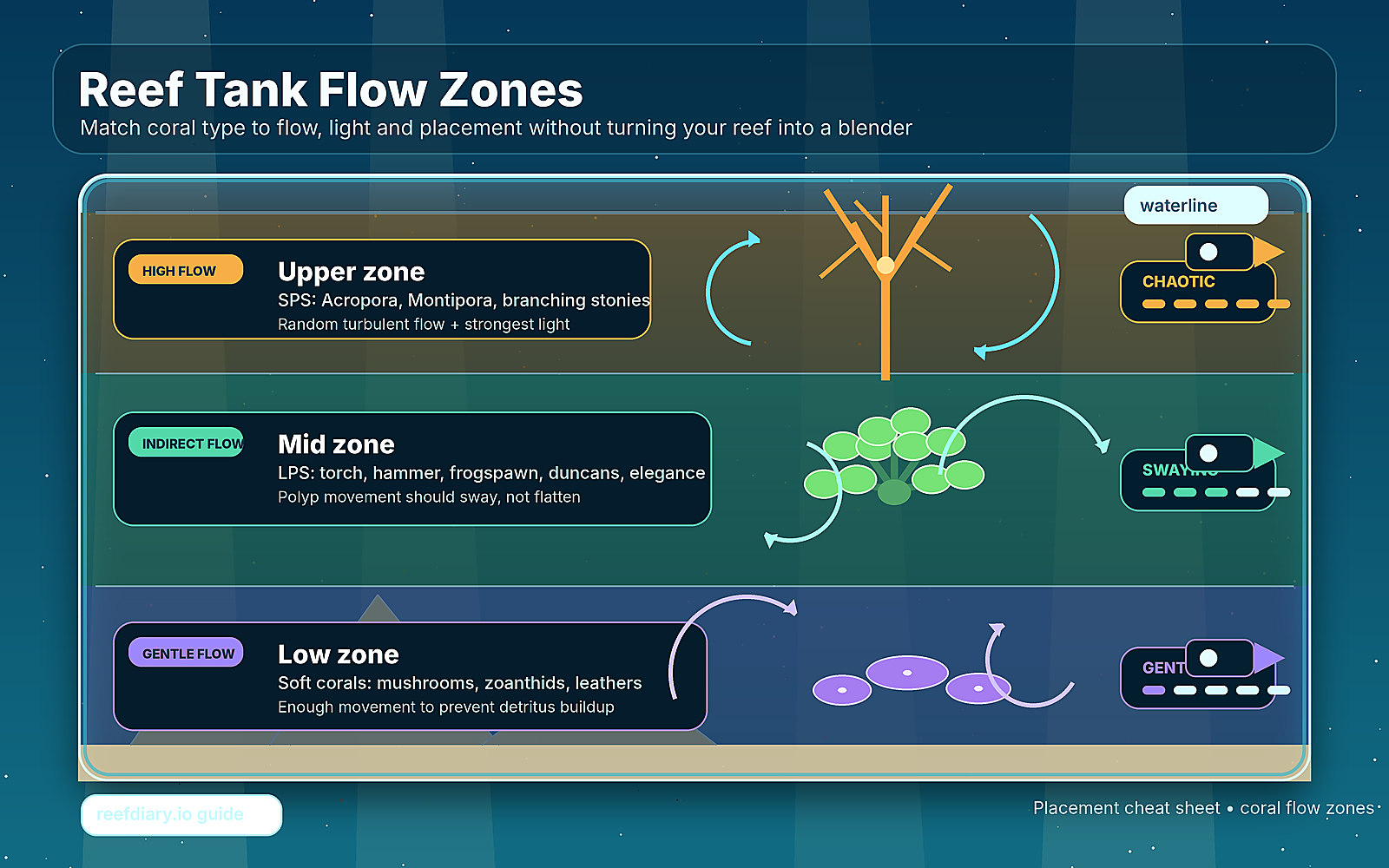
| Zone | Flow level | Coral types | Notes |
|---|---|---|---|
| Low / sandbed | Gentle, indirect | Soft corals (mushrooms, zoanthids, leathers) | Enough movement to prevent detritus buildup, not enough to fold tissue |
| Mid-tank | Low to moderate, indirect | LPS (torch, hammer, frogspawn, duncans, elegance) | Polyps should sway naturally, never get flattened by a direct jet |
| Upper rockwork | Strong, chaotic/random | SPS (Acropora, Montipora, other stony branching corals) | Random turbulent flow, not a single direct blast, delivers nutrients and clears detritus off delicate branches |
Soft corals generally sit lowest since they need the least light and flow. LPS occupy the middle ground. SPS goes highest where both light intensity and turbulent flow are strongest a direct powerhead blast isn't the goal even for SPS, it's chaotic, randomized movement that mimics open-ocean turbulence rather than a fire hose in one spot.
What actually fixes a sulking coral
If a coral's been contracted or dull for more than a few days with parameters otherwise stable, the fastest low-risk experiment is usually moving it, not dosing something new. Drop an Euphyllia lower and further from a powerhead if it looks folded over. Raise an SPS frag or reposition a wavemaker if a stony coral's base is receding and detritus keeps settling on it. Give it a week in the new spot before judging the result corals don't snap back instantly, but a genuine flow mismatch usually shows visible improvement (polyps extending further, better color) within several days.
The upside of ruling out flow first is that it costs nothing and can't make water chemistry worse. It's often the difference between a coral that limps along for months and one that's thriving within two weeks of a simple move.