Almost every reef tank gets scaped on the same day: the box of rock lands, the tank is empty, there's water waiting in bins, and the whole layout gets decided in about forty minutes. Then you live with it for three years. That mismatch minutes to build, years to live with is why aquascaping is the single decision in this hobby most likely to quietly cost you later. Not because a bad scape kills anything outright, but because it slowly makes everything else harder: flow that never quite reaches the back, a detritus pocket you can't siphon, and corals that hit the glass eighteen months in with nowhere left to go.
Quick answer: A good reef tank aquascape uses far less rock than most people expect roughly half a pound to a pound per gallon, not the old two pounds arranged as two or three separate structures with open sand between them. Keep the rock footprint under about three-quarters of the tank floor, leave 30–40% of the back wall clear, keep everything a few centimetres off every pane, and stop the rockwork around two-thirds of the tank's height so corals have somewhere to grow. Style follows from tank shape: one offset structure for nanos and cubes, two unequal bommies for standard rectangles, a central spine for peninsulas.
What is an aquascape actually for?
It's tempting to treat the rock as decoration, but the scape is doing three structural jobs before it does anything aesthetic, and the good-looking scapes are usually the ones that do those three well.
The first is flow. Water has to be able to lap the whole tank without hitting a wall, and anywhere it can't reach becomes a place where detritus settles and nutrients accumulate. The second is shelter fish need crevices, caves and overhangs to sleep in and retreat to, and a stocking list of wrasses and anthias in a tank with nowhere to hide is a stressed stocking list. The third, and the one almost nobody plans for, is real estate for coral over time. You are not building for the frags you have now. You're building for colonies that are ten times that size.
Aesthetics come out of getting those three right, not the other way round. A scape with open channels, unequal structures and negative space happens to look like a real reef, because on a real reef the water has to get through too.
How much rock do you actually need?
Less than you bought. The old "one to two pounds of live rock per gallon" rule came from an era when the rock was the filter, before skimmers, refugiums and modern flow did most of that work. Follow it now and you build a nutrient trap.
| Approach | Rock per gallon | What it produces |
|---|---|---|
| Old rule (retire it) | 1–2 lb | Solid mass, dead spots, no room to grow |
| Modern practice | 0.5–1 lb | Open structures, flow all the way around, space for colonies |
| Nano / AIO ceiling | 1 lb max, less with a sandbed | One clean structure instead of a filled box |
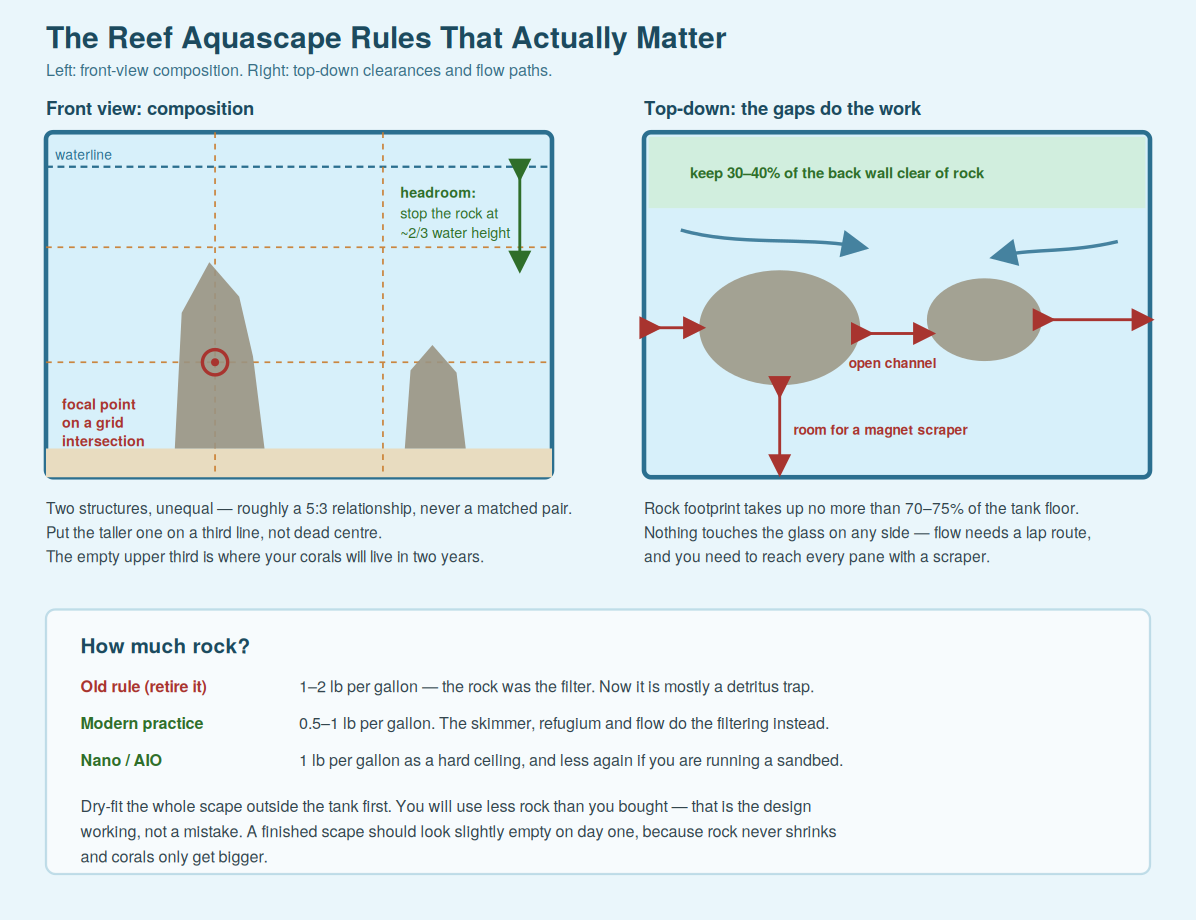
Two further numbers are worth holding onto while you're stacking: the rock footprint should take up no more than about 70–75% of the tank floor, and you should leave 30–40% of the rear wall volume free of rockwork. Both exist for the same reason water needs a lap route, and you need to reach the glass with a scraper.
The counterintuitive part is that a finished scape should look slightly empty on day one. If it looks full when the tank is bare, it will look overgrown and choked by year two. Rock doesn't shrink; corals only get bigger.
The four aquascape styles, and what each one suits
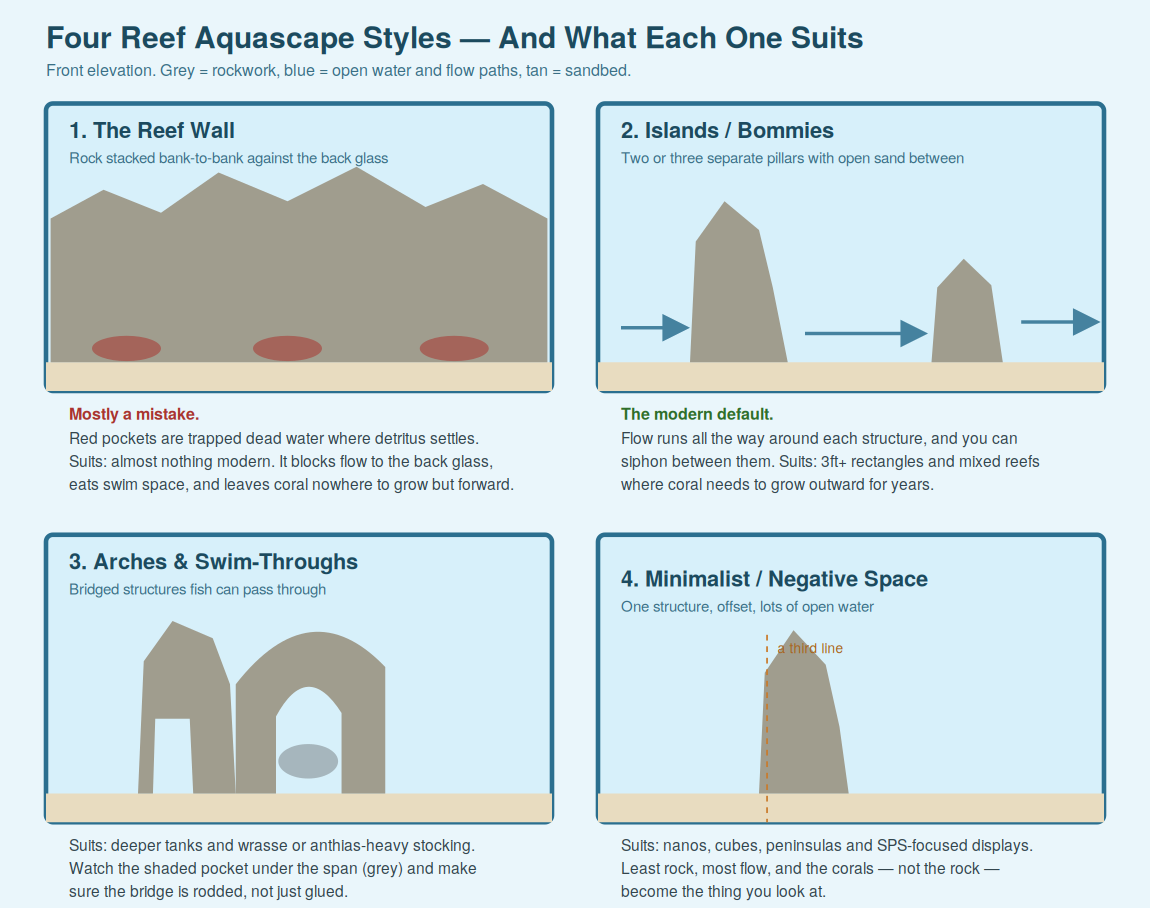
Most reef scapes are a variation on four shapes.
| Style | What it is | Suits | Watch out for |
|---|---|---|---|
| Reef wall | Rock stacked bank to bank against the back glass | Almost nothing modern | Dead spots behind and beneath, no swim space, no growth room |
| Islands / bommies | Two or three separate pillars with open sand between | 3ft+ rectangles, mixed reefs | Needs enough length to read as separate, not crowded |
| Arch / swim-through | A bridged span fish can pass under | Deeper tanks, wrasse and anthias stocking | Shaded pocket beneath the span; structural stability |
| Minimalist / negative space | One structure, offset, lots of open water | Nanos, cubes, peninsulas, SPS displays | Feels sparse for the first year that's the design working |
The reef wall is on the list because it's still the default beginner build and it's worth naming as the thing to avoid. It fails on all three of the jobs above at once: it blocks flow to the back glass, it converts swim space into rock, and it leaves corals nowhere to go but forward into the viewing pane.
Islands often called bommies, after the isolated coral outcrops on real reefs have become the modern default for good reason. Water gets right around each structure, you can siphon between them, and each pillar has its own light and flow character, which makes coral placement far easier to reason about later.
Which aquascape suits which tank?
This is where most generic advice falls apart, because a layout that's elegant in a 5ft rectangle is unusable in a 20-gallon cube.
| Tank type | Best layout | Why |
|---|---|---|
| Nano / AIO under 20 gal | One offset structure | Two focal points in a small tank read as clutter; keep the return nozzle a clear run |
| Standard 3–6ft rectangle | Two unequal bommies, roughly 5:3 | Enough length for separation, a clear channel between and a lap around the outside |
| Cube | One central pinnacle | No single "front" build a column that reads from every angle |
| Peninsula | A spine down the centre line | Viewed from both long sides; mass toward the wall end, tapering to the open end |
| Tall / deep (60cm+) | A taller, narrower pinnacle | Light falls off fast with depth, so the sandbed is a low-light zone, not an SPS shelf |
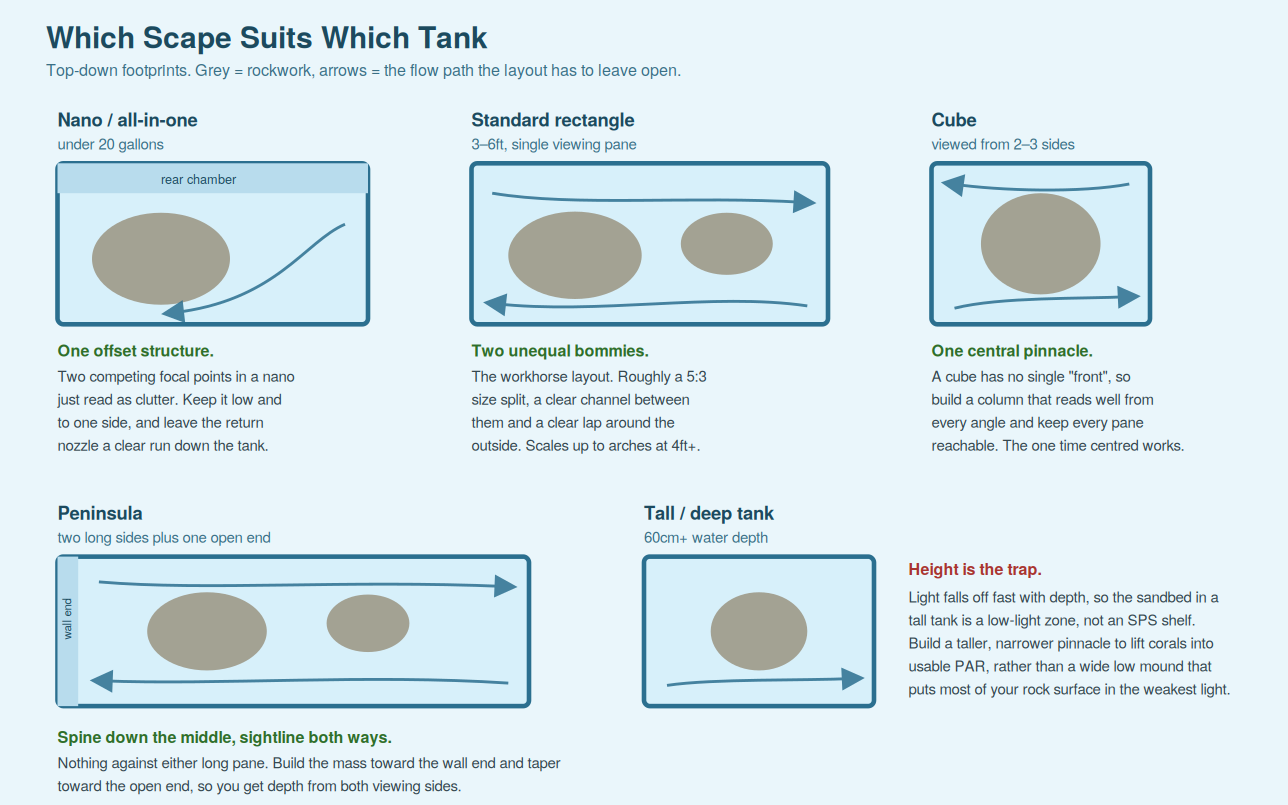
The tall-tank case catches people out most often. A wide low mound in a deep tank puts most of your rock surface in the weakest part of the light field. Building upward instead lifts coral into usable PAR without buying a bigger fixture.
How do you design a scape that doesn't strangle your flow?
Think in gaps rather than in rock. Every clearance you leave is a path water can take.
Keep the structure a few centimetres off every pane the back especially, but the sides and front too, because you need to get a magnet scraper down there without gouging coralline off the rock. Leave a channel between structures wide enough that a powerhead on the far side can actually push water through it. Avoid enclosed pockets at the base where detritus settles and nothing sweeps it out; an overhang is fine, a sealed cave at sand level is a nutrient sink.
And leave headroom. Stopping the rockwork around two-thirds of the water height feels wasteful when the tank is empty and looks obvious in eighteen months, when an Acropora colony has filled that space instead of pressing against the surface. Building the room in up front is dramatically less painful than breaking a scape down around grown colonies later.
Composition: thirds, ratios, and the space you leave empty
The aesthetic rules borrowed from planted-tank scaping are simple and they work.
Divide the front pane into thirds horizontally and vertically, and put your main structure and your strongest focal coral near where those lines cross, rather than dead centre. Make your structures unequal a rough 5:3 relationship in size or height reads as natural, a matched pair reads as furniture. Keep the rear glass relatively clear so fish and coral are seen against open water rather than against more rock.
None of this affects the health of the tank at all. It's purely how the thing looks but you're going to look at it every day for years, so it's worth the ten extra minutes at dry-fit stage.
Dry rock or live rock?
The two paths lead to the same place by different routes.
| Dry rock | Live rock | |
|---|---|---|
| Pest risk | Very low | Real aiptasia, bryopsis, mantis shrimp, predatory crabs |
| Cycling | Slower without seeding | Fast, biology already present |
| Cost | Lower | Higher |
| Shaping | Excellent cut, drill, cement freely | Limited, shapes are what you get |
| Early algae | Diatom and dino phases are common | Coralline present from the start |
Dry rock has become the mainstream choice largely because of pest control and because it lets you actually design a structure rather than assemble whatever shapes turned up. The trade-off is a longer, uglier settling-in period dry-rock tanks commonly work through diatoms and often a dinoflagellate phase before they stabilise. A hybrid approach mostly dry rock, with a piece or two of quality live rock added to seed biodiversity is a reasonable middle path if you're comfortable inspecting what you add.
How do you build it so it doesn't collapse?
Dry-fit the whole thing outside the tank first, on a towel, on a table. Most people discover their favourite layout on the third attempt, and discovering it inside a full tank is miserable.
Build from a flat, stable base rock not a rounded one propped up with rubble. Bond pieces with reef-safe cement or two-part epoxy, and use acrylic or fibreglass rods through the joints for anything tall or cantilevered; a rod through the core does more for stability than a large blob of cement on the outside. Let cement-based work cure before it goes in, and rinse it well. Then stand back and physically nudge the structure. If it moves, a tang will move it too and rockslides in a stocked tank are how corals get crushed and glass gets chipped.
The last check is the one people skip: put the powerheads and return where they'll actually live, run the pumps, and watch the water for a minute. It costs nothing to move a rock before the sand goes in, and quite a lot afterwards.
The mistakes that show up two years later
The scaping errors that hurt aren't the ones you notice on day one. They're the slow ones: the wall that leaves a strip of dead water behind it, the cave at sand level that turns into a detritus reservoir, the structure that reached the surface before the corals did, and the rock that sits flush to the glass so you can never quite clean that pane properly.
All four are cheap to avoid at dry-fit and expensive to fix once corals have encrusted the joints. Design for the tank you'll have in three years, and the first three months of looking a bit empty stop feeling like a problem.